When you’re out on the salt, every second counts. But you don’t have to guess where the fish are hiding. A high resolution fish finder gives you a clear shot at the action, even in murky water. Let’s break down six models that earn their keep.
| LUCKY Portable Handheld Fish Finder FFC1108 |  | Budget-Friendly Pick | Sonar Technology: Standard sonar with fish/school alarms | Display Size: 2-inch LCD | Maximum Depth: 328 feet (100 meters) | VIEW LATEST PRICE | Read Our Analysis |
| Garmin Striker 4 GPS Fishfinder with Transducer |  | Best Value | Sonar Technology: CHIRP sonar with ClearVu scanning | Display Size: 3.5-inch LCD | Maximum Depth: 1,600 feet (freshwater) / 750 feet (saltwater) | VIEW LATEST PRICE | Read Our Analysis |
| Handheld Fish Finder with Sonar Transducer |  | Portable Essential | Sonar Technology: 125 KHz sonar with 45-degree beam | Display Size: 3.5-inch color LCD | Maximum Depth: 164 feet (50 meters) | VIEW LATEST PRICE | Read Our Analysis |
| Humminbird 411660-1 Helix 5 Chirp GPS G3 Fish Finder |  | Best Overall | Sonar Technology: Dual Spectrum CHIRP sonar | Display Size: 5-inch TFT | Maximum Depth: Not specified | VIEW LATEST PRICE | Read Our Analysis |
| Garmin ECHOMAP UHD2 94sv with GT56 Transducer |  | Professional Grade | Sonar Technology: Traditional sonar, ClearVü, and SideVü scanning | Display Size: 9-inch touchscreen | Maximum Depth: Not specified | VIEW LATEST PRICE | Read Our Analysis |
| Garmin Striker Vivid 4cv Fishfinder with Transducer |  | Editor’s Choice | Sonar Technology: CHIRP traditional sonar and CHIRP ClearVü scanning | Display Size: 4-inch LCD | Maximum Depth: Not specified | VIEW LATEST PRICE | Read Our Analysis |
More Details on Our Top Picks
LUCKY Portable Handheld Fish Finder FFC1108
If you’re on a budget, the LUCKY Portable Handheld Fish Finder FFC1108 is your best bet for saltwater fishing. It’s a compact sonar device that shows you fish location, depth, and bottom features like weeds or rocks. The transducer sticks to your kayak or boat hull, reading depths from 3 feet to 328 feet. You get fish and school alarms, plus five sensitivity levels for clear or murky water. The 2-inch LCD screen stays visible in sunlight or dark, thanks to the backlight. Rechargeable battery lasts 4–5 hours, with a power-saving mode.
- Use it handheld or wear it on the included strap.
- Switch units between feet and meters as needed.
- Perfect for shore, boat, kayak, or ice fishing.
- Sonar Technology:Standard sonar with fish/school alarms
- Display Size:2-inch LCD
- Maximum Depth:328 feet (100 meters)
- GPS/Navigation:No GPS
- Mounting Options:Handheld/neck strap
- Water Rating:Not specified (suitable for freshwater and saltwater)
- Additional Feature:Fish and school alarms
- Additional Feature:Battery-saving mode
- Additional Feature:Neck strap wearable
Garmin Striker 4 GPS Fishfinder with Transducer
You get all the essential fishfinding tools without paying for features you won’t use. The Striker 4’s 3.5-inch screen (480 x 320 pixels) shows crisp Chirp sonar, which sweeps frequencies for better target separation. ClearVu scanning gives you near-photographic views of structure below, so you’ll spot brush piles or docks instantly. In saltwater, it reaches 750 feet; freshwater hits 1,600. You can mark waypoints on the built-in GPS map to return to hot spots later. Plus, the flasher mode shines for ice fishing or vertical jigging. Weighing just 8 ounces, it’s tough (IPX7 rated) and sips power at 0.23 amps. A 1-year warranty backs it.
- Sonar Technology:CHIRP sonar with ClearVu scanning
- Display Size:3.5-inch LCD
- Maximum Depth:1,600 feet (freshwater) / 750 feet (saltwater)
- GPS/Navigation:Waypoint map and navigation
- Mounting Options:Tilt/swivel mount, transom mount, motor mount, panel mount
- Water Rating:IPX7
- Additional Feature:Built-in flasher mode
- Additional Feature:Waypoint map marking
- Additional Feature:IPX7 water rating
Handheld Fish Finder with Sonar Transducer
The Xf-08 handheld fish finder is your ultimate shore-fishing sidekick. You’ll love its 3.5-inch color LCD, readable even in bright sun, and the wireless sonar sensor reaches down 164 feet. That 45-degree beam angle reveals grass, rocks, or sand bottoms. Fish icons show size, plus smart alerts keep you proactive. It’s powered by 4 AAA batteries or USB, and the water-activated probe turns on automatically. Compact and lightweight at 10.4 ounces, it’s ready for kayaking, boats, or ice. Just clean it after use, check the waterproof seals, and you’re set for smarter catches.
- Sonar Technology:125 KHz sonar with 45-degree beam
- Display Size:3.5-inch color LCD
- Maximum Depth:164 feet (50 meters)
- GPS/Navigation:No GPS
- Mounting Options:Handheld with lanyard
- Water Rating:IP67 (probe)
- Additional Feature:Water-activated auto on/off
- Additional Feature:Wireless sonar sensor
- Additional Feature:Fish size icons
Humminbird 411660-1 Helix 5 Chirp GPS G3 Fish Finder
For saltwater anglers demanding reliable performance, this Helix 5 stands out. You get a crisp 5‑inch TFT display with Dual Spectrum CHIRP Sonar. Switch between Wide Mode for covering big structure and Narrow Mode for pin‑point detail. The Low‑Q transducer helps you separate individual fish from the bottom. GPS comes loaded with Humminbird Basemap covering over 10,000 U.S. lakes and coastlines. Want more? Add LakeMaster or Navionics charts. AutoChart Live records depth contours, bottom hardness, and vegetation in real time up to eight hours. The keypad control works great in rough weather. You’ll appreciate the transom mount and included XNT 9 HW T transducer. It weighs just 2.1 pounds, easy to install.
- Sonar Technology:Dual Spectrum CHIRP sonar
- Display Size:5-inch TFT
- Maximum Depth:Not specified
- GPS/Navigation:Humminbird Basemap with 10,000+ lakes, AutoChart Live
- Mounting Options:Transom mount, gimbal bracket
- Water Rating:Not specified (reliable in various weather)
- Additional Feature:AutoChart Live mapping
- Additional Feature:Dual Spectrum CHIRP sonar
- Additional Feature:10,000+ lake basemap
Garmin ECHOMAP UHD2 94sv with GT56 Transducer
Built for serious anglers who demand professional grade performance, this 9-inch unit pairs a crisp touchscreen with keyed assist controls. You’ll love the sunlight readable display with enhanced viewing angles, perfect for bright saltwater days. The included GT56 transducer delivers sharp Garmin traditional sonar, ClearVü, and SideVü scans, showing you detailed fish arches and vivid color views around your boat.
- Navigation: Built in Navionics+ coastal charts plus multi-band GPS for rock solid positioning, even near tricky structures.
- Connectivity: Wi-Fi lets you share waypoints with other units; the ActiveCaptain app handles updates and OneChart features.
You can wirelessly link to a Force trolling motor for route following and speed control too. This fish finder earns its keep on the water!
- Sonar Technology:Traditional sonar, ClearVü, and SideVü scanning
- Display Size:9-inch touchscreen
- Maximum Depth:Not specified
- GPS/Navigation:Built-in Navionics+ coastal charts, multi-band GPS
- Mounting Options:Dashboard and panel mounting
- Water Rating:Not specified (marine environment rated)
- Additional Feature:LiveScope sonar compatible
- Additional Feature:Built-in Wi-Fi sharing
- Additional Feature:Multi-band GPS positioning
Garmin Striker Vivid 4cv Fishfinder with Transducer
If you fish saltwater on a budget, this Garmin is our editor’s choice. Its 4-inch LCD display uses high-contrast color palettes, so you’ll spot fish and structures instantly. The GT20 transducer delivers CHIRP traditional sonar and CHIRP ClearVü scanning sonar, giving you vivid underwater imaging.
You get high-sensitivity GPS for marking waypoints and creating routes. Plus, Quickdraw Contours lets you build custom maps with 1-foot depth intervals. The tilt/swivel mount helps you position the 11.2-ounce unit perfectly. It’s backed by a 2-year warranty, and your satisfaction is high. Simple, powerful, and affordable!
- Sonar Technology:CHIRP traditional sonar and CHIRP ClearVü scanning
- Display Size:4-inch LCD
- Maximum Depth:Not specified
- GPS/Navigation:Waypoint marking, route creation, Quickdraw Contours mapping
- Mounting Options:Tilt/swivel bail mount, transom and trolling motor mounts
- Water Rating:Not specified
- Additional Feature:Quickdraw Contours custom maps
- Additional Feature:High-contrast color palettes
- Additional Feature:2-year limited warranty
Factors to Consider When Choosing a Saltwater Fish Finder
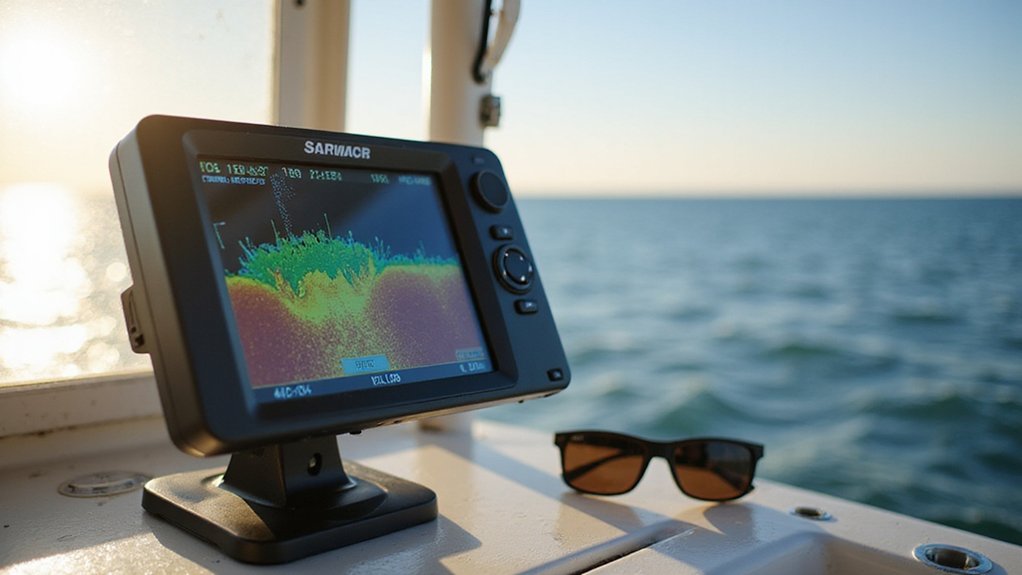
When you’re picking a saltwater fish finder, you need to zero in on five key factors: display size and readability, transducer type and power, depth and range capabilities, GPS and mapping features, and durability with waterproofing. The display matters because you’ll be fighting glare from the sun and sea, so a larger, high-contrast screen keeps your marks clear. And the transducer is your sonar’s heart, so match its power and frequency to the deep, salty waters you’re after.
Display Size and Readability
Since your fish finder’s display is your primary window into what lurks below the surface, choosing the right screen size and readability features makes all the difference. A larger display gives you better visibility, especially in harsh saltwater glare. You’ll want a high-resolution screen with anti-glare and sunlight-readable properties. Color displays help you differentiate fish, bottom types, and structure instantly.
And don’t forget adjustable brightness and backlight settings. These let you customize the view for dawn, noon, or dusk conditions. A clear, easy-to-read screen reduces eye strain and keeps you fishing efficiently. When you’re scanning miles of ocean, every detail counts. So prioritize a screen that’s big, bright, and sharp. That’s how you stay ahead of the schools below.
Transducer Type and Power
While display quality gets all the glory, your transducer is the real muscle behind your fish finder’s performance. You’ve got three main types to pick from: through-hull for a clean, permanent install; transom-mounted for easy DIY setup; or portable for quick trips. Your power output, measured in watts, directly controls how deep you’ll see and how crisp that underwater image becomes. Higher wattage is a must for deep saltwater hunting. And don’t forget frequency: 50kHz gives you depth penetration, while 200kHz delivers detailed imaging. Dual-frequency models give you both. Finally, always choose a corrosion-resistant transducer, because saltwater destroys cheap gear fast. It’s not glamorous, but this choice makes or breaks your fishing success.
Depth and Range Capabilities
If you’re heading out into deep saltwater, depth and range capabilities need to be at the top of your checklist. You’ll want a model that accurately detects bottom down past 1,600 feet for serious offshore trips. Your transducer’s wireless range also matters: signals can extend up to 656 feet, so you can fish far from the unit without losing data.
Look for adjustable sensitivity settings. They let you dial in detection as depths and water conditions change. Don’t settle for single frequency sonar; dual or multi-frequency options cover different ranges and underwater features much better. You need thorough bottom structure and water column coverage to spot structure and baitfish at various depths. Pick a fish finder that handles deep water without breaking a sweat, and you’ll consistently stay ahead of the school.
GPS and Mapping Features
When you’re out on the salt, GPS and mapping features turn your fish finder into a reliable navigation tool, not just a fish spotter. You can mark productive spots with waypoints, ensuring you’ll find that sweet spot again no matter the tide. And integrated charts, like Navionics or LakeMaster, reveal underwater topography, depths, and hazards. You’ll see contours and structures that hold fish, so you plan smarter routes. Real-time tracking logs your path, helping you avoid obstacles while you follow the bite. Plus, wireless sharing lets you sync mapping data with your phone or tablet. That means you strategize with your crew before you even drop a line. So, leverage these tools to read the water better and fish with precision.
Durability and Waterproofing
Saltwater doesn’t forgive, so your fish finder’s durability and waterproofing aren’t optional luxuries, they’re survival specs. You need an IPX7 rating or higher; that means it can survive a dunk without dying. Sealed buttons and ports keep corrosive salt spray from killing your touchscreen. Corrosion-resistant plastics and stainless steel components fight the relentless rust.
And don’t forget protective covers for the sensitive electronics, they shield against splashes and rain. Your unit should operate reliably at varying depths, even in high humidity. Waterproof housing isn’t just a feature; it’s the difference between a trusted tool and a salty brick. So, check those ratings. It’s a simple move that keeps your gear from becoming a victim of the sea.
Mounting and Portability Options
Three key factors shape your fish finder’s mounting and portability: how you’ll attach it, how easily you can move it, and how it fits your fishing style.
Think about your vessel first. Transom mounts bolt securely to small boats, while gimbal brackets suit dashboards. Suction cup mounts? Perfect for kayaks or rental boats, letting you swap locations in seconds.
For portability, go lightweight. Handheld units under a pound won’t fatigue your arm during long casts, and wireless models eliminate cable clutter entirely. Check the size against your storage space too; a bulky unit kills a packed tackle box.
Quick-release features are your friend. You want to pop the unit off in under a minute, whether you’re switching boats or heading home. Match the mount to your real-world setup, and you’ll never fight your gear when the tide’s running.