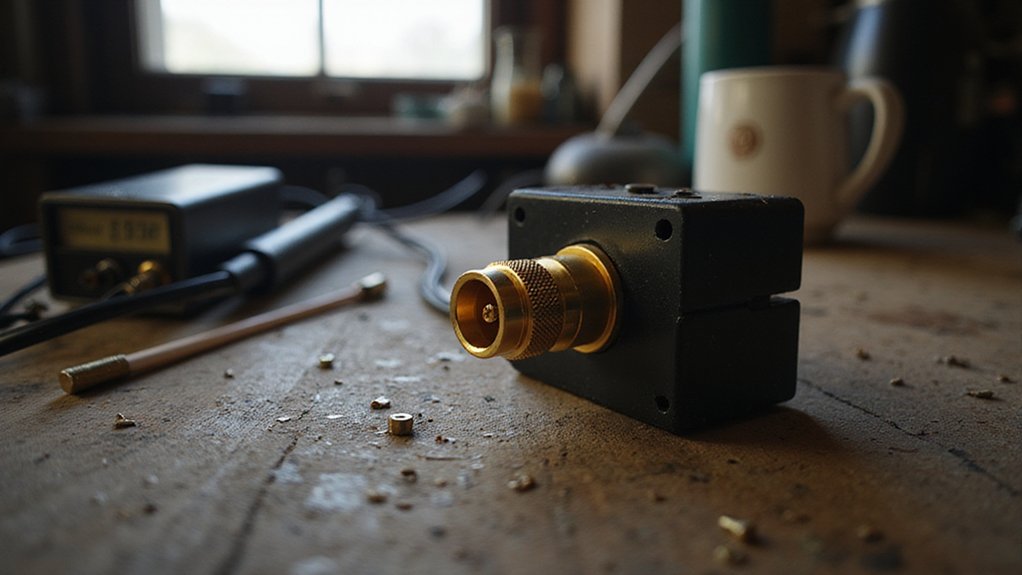
Ever wonder how the connectors on your coaxial cables match up and what they’re for? You might have heard of the female SO-239 socket and the male PL-259 plug, but what sets them apart?
These paired connectors are common in radio and HF equipment, offering reliable connections for lower frequencies.
Keep reading to see how to choose the right connector for your needs.
What Are SO-239 and PL-259 Connectors, Anyway?
The SO-239 and PL-259 connectors are a matching set of UHF connectors, with the PL-259 serving as the plug and the SO-239 as the receptacle. The PL-259 is attached to the cable, while the SO-239 is mounted on a chassis or panel. These connectors are built with a threaded coupling and a sturdy shell, which help resist vibration and rough handling. Installation is straightforward—you can solder the PL-259 onto coaxial cables like RG-8 or RG-213 without special tools. Although they are called “UHF” connectors, they perform best at HF (high frequency) and lower VHF (very high frequency) ranges, not true UHF signals. Their low cost, ease of field service, and durable design have made them a standard choice in ham radio, CB communications, and marine systems. For anglers integrating electronics on a boat, a depth finder often requires reliable coaxial connections to prevent signal loss. Securing the cable with a mounting bracket can help maintain stable signal integrity in marine environments. For clear communication on the water, a handheld marine band radio also relies on these connectors for consistent performance.

Type: (UHF Male) pl259 crimp connector + (UHF Female) SO-239 Crimp Connectors Kit

Impedance: Straight Style, Brass Material, Gold-plated Plating, 50 Ohm

THE MOST COMPLETE "MASTER" KIT (20 TYPES) –Onelinkmore upgrades your toolkit with 20 distinct adapter types, covering not just standard SMA/BNC, but also MCX, FME, TNC, and Mini-UHF. This is the ultimate "insurance policy" for Ham Radio operators and RF engineers—ensuring you can connect virtually any antenna (UHF Base) to any modern radio or SDR device instantly.
PL-259 vs SO-239: Which Is Male, Which Female?
The PL-259 is the male connector, and the SO-239 is the female connector. The male connector has a pin that inserts into the female socket on the SO-239. On your cable, you will find the PL-259, while the SO-239 is mounted on your radio or panel. This difference ensures proper mating and a reliable RF connection. Similarly, a fish finder relies on proper transducer setup to ensure accurate underwater readings and avoid signal interference. For the best results, choose a camera with a durable waterproof housing to withstand deep-water conditions. To choose the best equipment, review Top Fish Finders for Ice Fishing that compare sonar performance and battery life.
To maintain connector longevity and optimal performance, solder the PL-259 correctly; a cold joint can weaken the connection and cause signal loss. When installing, be careful not to overtighten the coupling ring, as this can crack the SO-239’s chassis threads. Tighten it just enough so it’s snug, then stop. The female socket remains stationary during connection, so protect its threads from cross-threading. Proper handling and installation will result in a durable, dependable RF connection over time.
Where You’ll Actually Find These Connectors Used
You’ll actually find PL-259/SO-239 connector pairs used across a variety of radio and communications setups. While amateur radio is a primary user, these connectors are common in many other applications. You’ll see SO-239 chassis jacks on the rear panels of HF, VHF, and UHF radios, providing a reliable connection point for coaxial cables. Correspondingly, PL-259 plugs are frequently used to terminate coax feeds, offering a threaded, secure connection.
In addition, CB radio systems depend heavily on this connector family thanks to their durability and threaded coupling, which prevents accidental disconnections. Marine and mobile communication systems also use these connectors because they resist vibration, making them ideal for ship-to-shore communications and mobile gear mounted on vehicles. During wireless troubleshooting, their robust, solid feel makes them a preferred choice. You can also spot these connectors on antenna tuners, SWR meters, and even older PA or CCTV systems. Their widespread adoption stems from their compatibility across many decades of gear, ensuring you can connect different devices without worry—from your shack to your vehicle. Similarly, a boat speedometer relies on a secure, vibration-resistant connection to maintain accurate readings in marine environments. This same vibration resistance is why top transducer mounts are also widely used on trolling motors in these environments. For anglers seeking the best performance on the water, selecting one of the top fish finders for boats ensures reliable sonar data even in rough conditions.

PL259 Connectors are made of high quality copper nickel plated material and gold plated contacts which have strong conductivity and are easy to solder. The insulator PTFE can ensure high temperature resistance during welding and will not melt.

Package include: 2 x adapters

Package Include: you will receive 20 PL-259 male crimp connectors, 20 matching crimp sleeves, 20 shrink tubes; 60 pieces, ideal for bulk installations, DIY projects, resellers, or frequent ham/CB users
Why Performance Falls Apart Above 150 MHz
Performance of a PL-259 or SO-239 connector pair begins to decline sharply above approximately 150 MHz. At these higher frequencies, the connector’s non-constant geometry creates impedance discontinuities, which act as lumped discontinuities rather than a smooth RF path. As the wavelength shortens, these irregularities generate frequency-dependent reflections, leading to poorer return loss and higher VSWR. The physical dimensions of the connector now constitute a significant fraction of a wavelength, making mismatches more noticeable. Although the insertion loss per connector remains modest individually, multiple connectors in a system cause cumulative losses, degrading the receive signal and increasing reflected power. The common designation as “UHF” is misleading; these connectors were not optimized for today’s higher frequencies. Practical operational limits typically fall between 100 and 150 MHz, beyond which performance becomes unreliable. For comparison, modern fish finders for catfish rely on sonar transducer connectors that maintain performance at much higher frequencies.

Ideal for connecting 2 F-Pin cables, and extending the connection of a cable box, TV, satellite receiver, VCR, cable modem, off-air antenna or other digital audio/video component. Each connector comes individually packaged to guard from scratches.


CONNECTOR 1 ---- BNC female, Nickle plated brass; CONNECTOR 2 ---- SMA male, Gold plated brass
When to Choose N-Type, BNC, or SMA Over UHF Connectors
If your system operates above 150 MHz or needs to handle weather, mechanical stress, or repeated connections, N-Type, BNC, and SMA connectors are preferable choices over UHF. N-Type connectors are sealed and rugged, making them ideal for outdoor use such as base stations and hardline installations. They offer low loss and reliable weatherproofing when tightened properly to the specified torque. BNC connectors are designed for quick, tool-less connections with a bayonet lock, making them suitable for laboratory testing and frequent reconfiguration. Their ease of use speeds up swapping test gear but may not provide the same weatherproofing as N-Type connectors. SMA connectors are small, precise, and perfect for compact radios or software-defined radios (SDRs), fitting into tight spaces where size matters. To ensure optimal performance, avoid over-tightening SMA connectors to prevent damage, and always tighten N-Type connectors to the recommended torque for weatherproof sealing. For a faulty fuel sender, check for erratic fuel gauge readings as a common sign of failure. UHF connectors are best reserved for low-frequency, legacy applications where cost is a primary concern.