Ever wonder how a night vision camera lets you see in complete darkness? These devices work by capturing invisible infrared light, detecting heat, or amplifying faint starlight to produce clear images.
Most models use infrared LEDs to bounce light, while thermal cameras sense heat patterns.
Keep reading to learn how to choose the right setup for your needs.
How Infrared Night Vision Cameras Turn Invisible Light Into Images
Infrared night vision cameras convert invisible IR light into images by illuminating a scene with near-infrared light, typically in the 850–940 nm range. This IR light bounces off objects similarly to visible light, and the camera’s sensor detects the reflected energy. The sensor’s sensitivity is crucial: specialized or modified CMOS and CCD chips absorb the IR light and transform it into electrical signals. Brighter reflections produce brighter pixels on the resulting image. During nighttime use, an IR-cut filter automatically slides away, allowing the sensor to capture IR light instead of visible light. The image processor then translates the signal intensities into grayscale, revealing shapes and motion that are invisible to the naked eye. The outcome is a sharp, black-and-white image constructed entirely from infrared light, enabling you to see in complete darkness. This technology is similar in principle to how fish finders emit signals to detect underwater objects. Both systems rely on transducer technology to convert received energy into meaningful visual data.

【5K Cinematic Clarity & Versatility】 This digital video camera captures stunning 5K/20fps videos (also 4K/60fps) and 64MP photos with a high-sensitivity CMOS sensor. Perfect for vlogging, travel films, podcast recording, family events, and interviews, delivering cinema-grade detail even in motion.
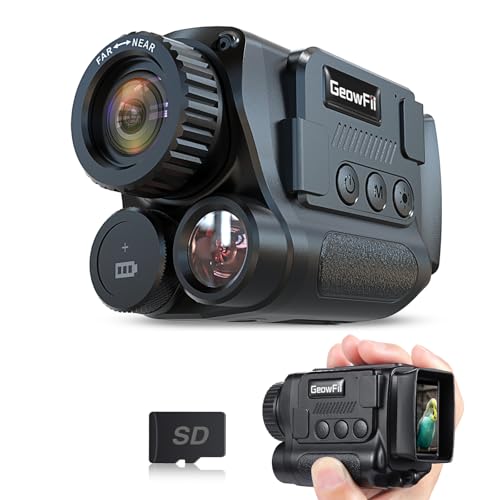
4K Upgraded & Practical—— GeowFiiTech Night Vision Monocular features a 4K version with a 25mm multi-coated lens, enhancing imaging for day and night use. With 4K video, 40MP photos, and essential functions, this monocular night vision meets outdoor needs effectively
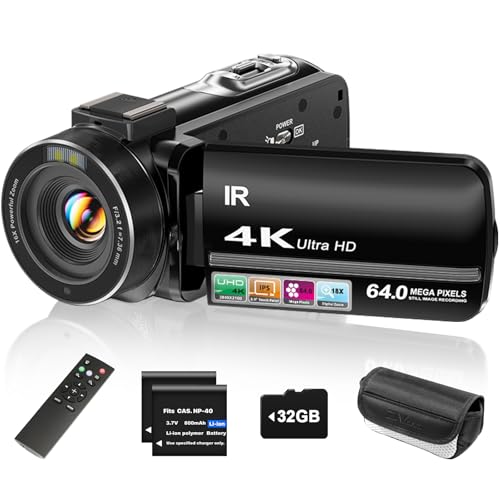
4K & 64MP Video Camera Camcorder: Capture life in breathtaking detail with 4K Ultra HD recording and vibrant 64MP photos, powered by an advanced high-sensitivity CMOS sensor. Equipped for exploring the beautiful world, this video camera is your perfect companion! Ideal for video recording, travel vlogs, family activities, interviews, studying, and cherishing precious moments
Why Some Night Vision Cameras Amplify Starlight Instead of Using LEDs
Some night vision cameras amplify starlight instead of using LEDs because they rely on ambient light sources like the moon, stars, or streetlights. This passive approach allows the camera to operate without emitting any light, making your surveillance completely discreet. Specialized image sensors are designed to detect extremely faint ambient light, capturing the scarce photons that reach them. Inside the camera, an image intensifier multiplies these photons thousands of times, converting them into a bright, clear image. This method avoids the visible or infrared illumination that can reveal standard IR cameras, making it ideal for stealthy monitoring. While starlight cameras perform well in low-light environments with minimal light pollution, they require some ambient light to function effectively. For anglers, understanding this principle is similar to selecting the best fish finders for nighttime catfishing. Additionally, just as proper transducer orientation on a trolling motor ensures accurate sonar readings for fish finders, correctly aligning your night vision camera’s lens toward available ambient light sources maximizes its performance. For example, choosing a camera with high sensitivity sensors can be as critical as selecting a Garmin Striker 4 model with clear ice fishing flasher technology.

【Free Cloud Storage & Local SD Card】Enjoy free cloud storage with no subscription fees, access recordings anytime. Also supports up to a 256GB SD card (sold separately) for flexible local backup and enhanced data security. (Note: The free plan will be activated within 24 hours. Please ensure you are using the "Eseecloud" app for the free cloud storage to be granted automatically. If you do not receive it, or if you encounter any setup or usage questions at any time, please feel free to contact customer service for prompt assistance.)

【Drill-Free Quick Installation & Dual-Band Wi-Fi】 YesPano window camera features a peel-and-stick design that quickly installs on glass surfaces in just 30 seconds—no drilling required, so it won't damage doors or windows. The mounting sticker can be easily removed without leaving a mark. Built on 2.4GHz / 5GHz dualband Wi-Fi and Bluetooth connectivity for quick app connection, stable and buffer-Free streaming.
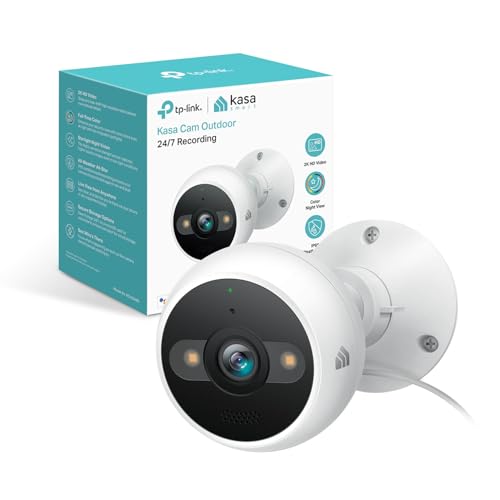
IP65 WEATHER RESISTANT: Built for outdoor use with an IP65-rated design that helps protect against dust and water. Operating temperature: -4°F to 109°F (-20°C to 43°C).
What Makes Thermal Night Vision Cameras See Heat Patterns in Total Darkness
Thermal night vision cameras see heat patterns in total darkness by detecting the infrared radiation emitted by objects. They do not require visible light to function. These cameras use a microbolometer array that operates within the 8 to 14 micrometers (µm) long-wave infrared (LWIR) band, where objects at room temperature emit strong infrared signals. When infrared radiation strikes the detector, each pixel warms slightly, altering its electrical resistance. The camera’s readout electronics then convert these resistance changes into a thermal image.
Sensor sensitivity is crucial for contrast. Different materials emit varying infrared intensities, which makes living beings, engines, and walls appear as bright or dark regions in the image. Remember, you are not directly seeing heat but rather the variations in emission intensity. Calibration techniques help correct sensor drift and uneven pixel responses, ensuring more accurate images. Additionally, factors such as emissivity—how effectively an object emits infrared radiation—are considered, especially with shiny surfaces that emit less infrared radiation than matte ones. Atmospheric conditions like humidity and distance can blur the heat patterns, but even with these challenges, thermal cameras reveal surface temperature differences that are invisible to your eyes. This concept is similar to how CHIRP fish finders use frequency variations to improve underwater target separation and clarity. For those comparing detection technologies, the microbolometer sensor functions analogously to a sonar transducer by converting subtle energy changes into a clear image. To maximize visibility in murky water, anglers often pair thermal imaging with a waterproof housing to protect the camera while maintaining a stable view of the seabed.

Built-in Compass for Easy Navigation – Our 4K digital night vision binoculars feature a built-in compass, ensuring you stay on track in the wild. Whether for tactical use, infrared (IR) night hunting, or outdoor adventures, these nocturna nightvision goggles provide reliable navigation in complete darkness.

UNMATCHED CLARITY: With a high IR resolution of 256x192 and a smooth 50Hz refresh rate, the thermal monocular provides vivid thermal images, capturing every detail of your surroundings with precision.

𝐔𝐍𝐈𝐕𝐄𝐑𝐒𝐀𝐋 𝐂𝐎𝐌𝐏𝐀𝐓𝐈𝐁𝐈𝐋𝐈𝐓𝐘: The RISION Magic thermal imager offers USB-C port that works with iOS, Android & Windows devices. Note: Mac devices are not supported.
Why Night Vision Cameras Usually Show Black-and-White (or Green) Images
Night vision cameras usually display black-and-white or green images because of how they detect and present light in low-light conditions. Color perception relies on visible light, but in darkness, sensors capture reflected infrared radiation instead. This results in a loss of color data but improves overall image clarity. Monochrome images conserve luminance information, which enhances contrast, sharpness, and the visibility of edges and shapes. As a result, faint details become easier to distinguish. Green images originate from analog intensifier tubes that use a phosphor screen emitting green light. The green hue allows for numerous shades to be differentiated in dim conditions, making it a popular choice for night vision. Modern digital cameras often bypass the green phosphor, displaying black-and-white video for a more neutral appearance. Some modes utilize white phosphor or grayscale settings, which produce images that look more natural without the green tint. Regardless of color scheme, the monochrome output reduces noise and improves the detail sharpness in low-light scenes, outperforming color-based images in darkness. For marine applications, selecting the right autopilot for sailboat can help maintain a steady course while using night vision systems. Achieving this clarity in any environment, whether on land or water, often requires reliable mounting and wiring techniques to maintain a clean, uninterrupted electrical connection. For optimal performance when using a night vision system on a boat, pairing it with a fish finder portable kit can help navigate shallow waters and identify underwater obstacles.
When Night Vision Cameras Struggle: Range, Reflection, and Cost Limitations
Night vision cameras face significant limitations with range, reflection, and cost that can reduce their effectiveness in real-world conditions. Typically, usable detail drops sharply beyond 20 to 30 meters, and environmental factors like dust or humidity can decrease this range further. Outdoor units must also be durable enough to withstand weather, impacts, and other outdoor risks.
Reflections pose another major challenge. Glare from glass, mirrors, or wet surfaces creates bright hotspots that obscure faces or license plates. While angling the camera might help, it complicates installation, especially when avoiding reflective surfaces becomes difficult.
Cost constraints heavily influence what you can achieve. Budget infrared cameras usually offer a range of only 15 to 25 feet, which restricts their use to very close distances. Mid-range systems cost between approximately $400 and $900, and additional illuminators start at around $250. Long-range setups quickly become expensive because premium infrared performance requires stronger LEDs and tighter beam control. Balancing your budget with your coverage needs is essential to get the best performance without overspending.
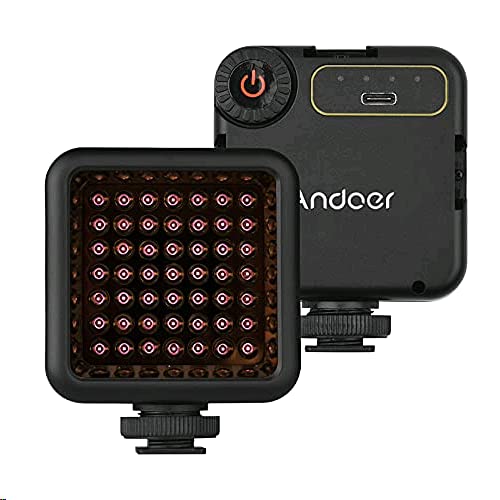
Versatile Lighting: Ideal for vlogging, video recording, and photography, this compact IR light ensures you're always ready to capture stunning footage in low-light conditions

【Versatile & Universal Fit】 Transform any standard rifle scope with an eyepiece diameter of 38-44mm into a powerful night vision system. This DIY kit comes with everything you need to get started.

Day/Night Vision: IR-CUT Filter switched in and out automatically based on light condition (only visible light during the daylight and infrared sensitivity during the night with 850 IR LEDs on)