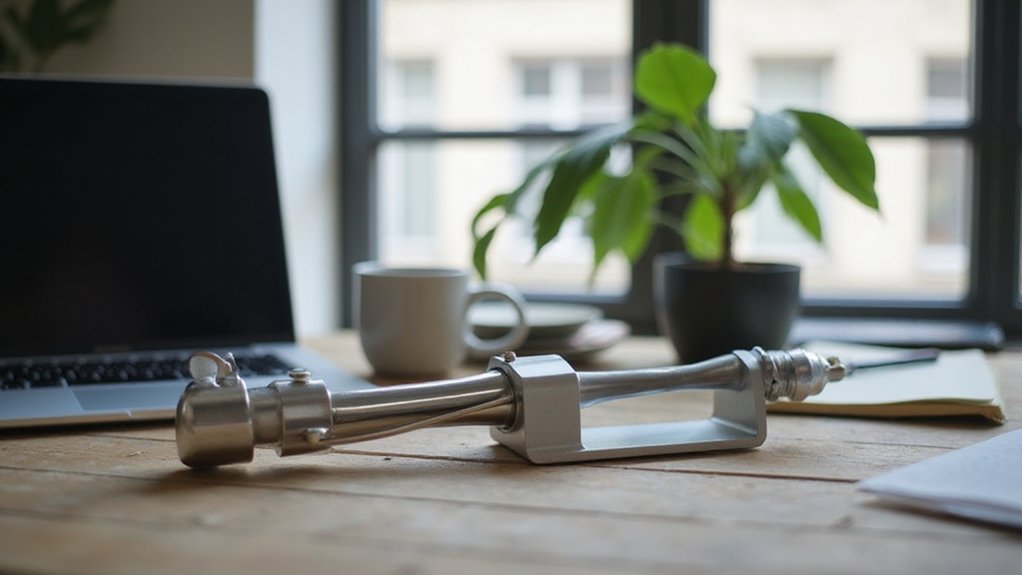
Finding the right type of pitot tube for your flow measurements can be tricky, especially with different designs suited for specific conditions.
Whether your flow is clean and stable, dirty and moist, or large and non-uniform, choosing the right style ensures accurate readings.
Keep reading to understand how each type stacks up and what factors influence your choice.
How Pitot Tube Types Handle Dirty, Clean, and Non-Uniform Flows
Dirty flows pose a significant challenge for pitot tubes because their pressure ports tend to clog with dust, particles, or buildup. In slurry-like services, conventional pitot tubes are generally unsuitable because contamination causes drift, false low readings, or complete signal loss. Dusty gas applications require frequent declogging or purge systems to maintain accuracy; without these, maintenance becomes more demanding to prevent unexpected downtime. Similarly, when choosing the best anchor light for your sailboat, you must consider durability and resistance to the harsh marine environment to avoid frequent failures. When selecting a power source, a fish finder battery with charger must also be chosen carefully to ensure reliable performance in harsh conditions. For ice fishing, a Garmin Striker 4 offers reliable sonar performance in cold, dirty water conditions. Clean flows, such as those involving gases, liquids, or steam, are where pitot tubes perform best. Their ports stay open and unobstructed, resulting in improved repeatability and less maintenance. Handling non-uniform flows is more complex. Single-point probes can misrepresent uneven velocity profiles, especially downstream of elbows or dampers. To improve accuracy, consider using an averaging pitot tube or incorporating flow conditioning devices to measure across the cross-section effectively.
Standard, S-Type, or Averaging Pitot: How to Choose
A standard pitot tube is the best choice for clean, uniform flows where you can perform a full traverse. It’s straightforward, inexpensive, and ideal for quick spot checks. However, keep in mind that its accuracy depends heavily on your skill in traversing the flow profile without missing deviations. For those new to this process, learning to interpret sonar display readouts can improve overall measurement confidence. Unlike a thru-hull transducer, which requires a hole in the boat’s hull, a standard pitot tube is mounted externally and does not compromise hull integrity.
In environments with particulate matter or condensate, an S-type pitot tube is recommended. It’s designed to handle dirty or moist conditions by preventing plugging and contamination of the measurement ports. Be careful not to confuse it with an averaging device, which serves a different purpose.
For large pipes or ducts where continuous monitoring is needed, an averaging pitot tube is superior. Its multiple ports collect pressure data over a wide area, providing a single representative measurement. This setup eliminates the need for manual traverses and reduces installation time, particularly when profile mapping is difficult or impractical. For a reliable power setup to keep these instruments running, consider boat switch panels that integrate fuses for quality and value. When selecting a thru-hull transducer, boat owners should weigh the advantages of flush-mount designs for minimizing drag and turbulence.

20-foot enough length of tubing provides ample reach to accommodate various boat sizes and configurations.

L Type 304 Stainless Steel Pitot Tube

Pitot tube delivers accurate speedometer reading
Tube Sizes, Materials, and Temperature Ratings by Pitot Type
Standard straight pitot tubes typically feature probe diameters from 2.3 mm to 14 mm and insertion lengths up to 3 meters. Material choice is usually stainless steel, with 316L stainless steel being the most common due to its corrosion resistance and durability. Temperature ratings for these probes generally reach 600°C as standard; high-temperature variants can withstand up to 1000°C, making them suitable for demanding industrial environments. When selecting a straight pitot tube, consider your process conditions to ensure the material and temperature ratings align with your application’s requirements. For float tube anglers, a reliable fish finder transducer is essential for accurate depth readings. Calibration techniques rely heavily on the material’s thermal expansion and corrosion resistance, which help maintain accuracy across various process ranges. For safe and accurate electrical integration of related sensor outputs, ensure you follow proper relay wiring principles when connecting signal circuits to avoid voltage spikes. Additionally, proper transducer orientation on the trolling motor ensures sonar readings remain accurate and free from interference caused by water turbulence.
Calculate Flow Using Your Pitot Tube’s Coefficient
To calculate flow using your pitot tube’s coefficient, start by measuring the differential pressure \(\Delta P\) with a pressure transducer or \(\Delta h\) with a manometer. Next, determine the fluid density \(\rho\). Calculate the theoretical velocity using the formula \(V_t = \sqrt{2\Delta P/\rho}\) if you have \(\Delta P\), or \(V_t = \sqrt{2g\Delta h}\) if using \(\Delta h\). Multiply this velocity by your pitot tube coefficient \(C_p\), which typically ranges from 0.98 to 1.0, to obtain the actual flow velocity: \(V = C_pV_t\). Finally, multiply the actual velocity by the pipe’s cross-sectional area \(A\) to find the flow rate \(Q = AV\). Ensuring the accuracy of your coefficient is critical because an incorrect calibration can lead to significant errors. To achieve precise results, perform flow profiling across the pipe or use an averaging design to verify your tube measures a representative velocity. Calibration against a standard or actual flow measurements allows you to derive your true coefficient. Repeating this calibration at different flow rates helps build confidence in your readings and minimizes errors. Similar to fuel tank sending units, the reliability of your pitot tube depends on selecting a model that is precisely matched to your specific measurement conditions, much like a night vision camera must be calibrated for low-light environments to ensure accurate image capture. Just as a fish finder requires down imaging technology to clearly visualize underwater structures for accurate target identification, your pitot tube needs consistent calibration to reliably measure flow velocity in varying conditions.

【Compatible Model】 Compatible with MATEK ASPD-4525 digital airspeed sensor, this kit is precision-engineered to meet the exact specifications of the original component. It serves as a highly accurate measurement tool and an ideal replacement part for flight controller setups.

Dual Port Bidirectional Monitoring: Delivers dependable positive and negative air monitoring from minus 0.3 to 0.3 psi through dual ports, featuring a stable DC 0.5V to 4.5V analog output range with a dedicated 2.5V baseline offset for precise signal tracking on microcontrollers.

pressure transducer /pressure Sender/ Pressure Transmitter, Our material is using top of line 316 stainless steel (not 304)and high temperature auto-graded plastic
Avoid Installation Mistakes That Skew Pitot Tube Accuracy
Installing a pitot tube correctly is essential, but even with a properly calibrated coefficient, mistakes during setup can cause significant errors. One critical error to avoid is poor straight-run placement. Insufficient upstream and downstream pipe length creates turbulence that disrupts accurate velocity measurement, so ensure there are enough straight pipe sections—typically at least 10 times the pipe diameter upstream and five times downstream. Misaligning the probe with the flow direction is another common trap; even a yaw angle of a few degrees can reduce accuracy significantly. Always align the probe axis parallel to the flow, and double-check using flow visualization if possible. Radial positioning also matters: your probe tip must sit at the specified depth within the pipe, not too close to the wall or at the centroid if recommended. Incorrect positioning can sample biased velocity zones and skew readings. For gases, position the probe in the upper half of the pipe to avoid condensate buildup, which can interfere with the measurements. Additionally, ensure holes are cleanly drilled and impulse lines are kept short and equal in length. When selecting a marine electrical system, paying attention to the layout of your boat switch panel can prevent power distribution issues separate from flow measurement. These installation details are just as vital as calibration procedures; neglecting them diminishes your pitot tube’s accuracy and reliability. For a similar focus on precision, as with a thru-hull transducer, proper mounting and alignment are critical to avoid errors. When selecting flow measurement gear, many boaters rely on the best GPS speedometer for backup validation of their pitot readings.

Fits: 1", 1-1/4", 1-1/2", and 2" O.D. Tube – Ensure you choose the correct size for your project.

Fits: 1", 1-1/4", 1-1/2", and 2" I.D. Pipe – Ensure you choose the correct size for your project.