Ever wonder which side of your boat should have the navigation lights? Knowing where to place the red and green lights is key to staying safe and understanding other boats at night.
Usually, the red light goes on the left side and the green on the right, helping everyone see which way boats are headed.
Keep reading for the full details on proper navigation light placement.
Which Side Gets the Red Navigation Light on a Boat?
The red navigation light is displayed on the port side of your boat—that’s the left side when you’re facing forward towards the bow. This color coding follows a universal standard called COLREGs to ensure safety at night. The red light covers an arc of 112.5 degrees, visible from dead ahead to 22.5 degrees behind your left beam. These signals help other boaters determine your orientation instantly, especially in low-light conditions, and see only a red light means they are viewing your port side. Remember the simple mnemonic: “red on the left” when looking forward. This fixed color pairing makes it easy to identify vessel directions during nighttime navigation, reducing the risk of collisions and ensuring safe passage. For more precise vessel tracking in low visibility, many modern boaters also rely on side imaging sonar to view underwater structures and avoid hidden hazards. A properly functioning fuel tank sending unit is equally critical for monitoring fuel levels during extended night voyages to prevent unexpected engine cutouts. Choosing a quality depth finder for your boat can further enhance safety by revealing submerged obstacles in your path.

[Bright LEDs] Each navigation light built in 8LEDs,the illumination angle of red and green are both 112.5 degree , which can improve the safety when boating, especially at night; red for port side and green for starboard side;

Product Dimensions: 4.09 x 2.52 x 1.34 inches; Voltage: DC 12V-24V; Wattage: 3W

Product Dimensions: 4.09 x 2.52 x 1.34 inches; Voltage: DC 12V-24V; Wattage: 3W
Which Side Gets the Green Navigation Light on a Boat?
The green navigation light is mounted on the starboard side of the boat—the right side when facing forward toward the bow. This color coding is universal: green always indicates starboard, while red indicates port. Proper placement of the green light ensures it covers an arc of 112.5°, from straight ahead to 22.5° abaft your starboard beam. You rely on this light to signal your right side to other vessels at night or in low visibility conditions. When you see green from another boat, you are likely looking at its starboard side, which helps you make safe right-of-way decisions. The green light is part of the standard red-green-white navigation lighting system required by international rules. Correct placement guarantees other vessels can interpret your heading clearly to avoid collisions. Unlike an anchor light, which is an all-round white light used when a vessel is stationary, the green navigation light indicates your direction of travel to other boaters. For a reliable electrical connection, you should install a horn relay to handle the high current load without overheating the switch. If your pontoon boat needs an audible warning device, consider choosing a powerful horn that meets Coast Guard requirements for sound output.
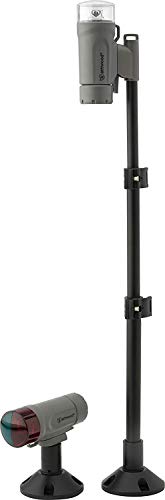
ULTIMATE NIGHTTIME VISIBILITY: Stay safe on small boats or tenders without 12V systems using these compact, high-intensity LED navigation lights

【4PCS BRIGHT LED LIGHTS】, each LED light includes 5pcs SMD LED on the PCBA board, bright; 3 different colors for different purposes, 1pc red and 1pc green for 2 sides of boat bow and 1pc white for boat stern, 1pc extra white for backup; 3 lighting Modes [Steady, Flash, and Strobe]

2-NM USCG CERTIFIED VISIBILITY: Engineered to keep you safe and legally compliant on the water, this 2-Nautical Mile navigation light meets strict U.S. Coast Guard, ABYC A-16, and global EN/ISO 19009 regulatory standards. It features sharp cut-off angles and a vibrant green LED for unmistakable starboard-side identification.
What’s the Easiest Way to Remember Red and Green Lights?
The easiest way to remember red and green lights is with the mnemonic “red port left.” This simple phrase helps you quickly associate red with the port side of your boat, which is traditionally on the left. Pair it with “green means go,” which is a familiar traffic light cue, to remember that green sidelight indicates the starboard (right) side and signals that the vessel is moving or safe to pass. Another helpful tip is “port wine is red,” linking the color red to port, the left side of a ship. These associations allow you to instantly recall which light is which, especially in low-light conditions or at night. Repeating these phrases solidifies your understanding and ensures fast, accurate identification of vessel lights, reducing confusion and improving safety on the water. For those who enjoy listening to music while boating, selecting marine bluetooth speakers with excellent sound quality can enhance the overall experience on the water. Anglers also benefit from modern electronics like catfish fish finders that help locate fish even in low-visibility conditions. For ice fishing, using a reliable unit such as a Garmin fish finder ensures accurate readings beneath frozen surfaces.

Pack of 2 (1 Red & 1 Green): TMH 3 Inch Navigation lights designed for bow port and starboard positions, allowing other vessels to clearly identify your direction at night.

1.Enhanced Visibility & USCG Compliance:Our boat navigation lights feature a proprietary optical design with red and green lenses housed in a corrosion-resistant, triple chrome-plated zinc cover. Ideal for late-night boating, these LED navigation lights ensure 2 nautical mile visibility, meeting USCG requirements for safety in fog and mist.

Visibility & Safety: Red and green LED navigation lights provide up to 225° visibility for safe night boating. Perfect for small boats, pontoon, and fishing vessels under 39.4 ft (12 m), compatible with 12V DC systems
Why Does Red Always Mean Left and Green Mean Right?
The choice of red for port and green for starboard originates from maritime safety practices established in the 19th century. Back then, ships needed a clear and consistent visual system to prevent nighttime collisions. Red was assigned to port—the left side when facing forward—because it’s easily visible and distinguishable, even in low light. Green was designated for starboard—the right side—due to similar reasons of visibility and contrast.
This color coding became official with the UK’s Steam Navigation Act of 1846 and was standardized by the British Admiralty in 1847. The colors were specifically chosen because they stand out distinctly against the dark waters, reducing the chance of confusion among vessels. When you see a red light, it indicates the other vessel’s port side, which often signals you to give way. This system was so effective that it was adopted internationally, enabling quick and accurate interpretation of vessel orientation in night navigation, which ultimately enhanced maritime safety worldwide. Unlike a binnacle compass, which is housed in a standalone mount and used for steering, navigation lights are fixed to the hull and serve a different collision-avoidance purpose. For kayak anglers, selecting a compact and durable unit can be as crucial as mounting these lights, since fish finder performance often dictates how safely you position your boat near traffic at dusk. Anglers can improve their situational awareness by pairing these navigation lights with a device that offers live sonar for real-time underwater tracking.
What’s the Standard Sidelight Visibility Range?
The standard sidelight visibility range depends on your vessel’s length. For boats under 12 meters, the lights must be visible for at least 1 nautical mile. If your vessel is between 12 and 50 meters, the required range increases to 2 nautical miles. For vessels 50 meters or longer, the lights need to be visible for at least 3 nautical miles. These requirements are based on international regulations, specifically the COLREGs framework and navy standards. Each sidelight covers an unbroken 112.5-degree arc from dead ahead to 22.5 degrees abaft the beam on its side, ensuring clear visibility from different angles. It’s essential to verify your boat’s size and confirm your sidelights meet these minimum visibility ranges, as compliance is mandated by law. For reliable navigation, many boaters also upgrade to a Garmin EchoMap UHD 93SV with GT54 transducer to enhance chartplotting and sonar performance. Proper transducer orientation on a trolling motor is critical for accurate depth readings and fish arches. Navigation lights must also be displayed during periods of restricted visibility such as fog or heavy rain, as required by the COLREGs.

Reliably provides lighting that is visible for at least 1 nautical mile

BRIGHT UP TO 2 NAUTICAL MILES: LED boat navigation lights provide brilliant illumination, making your vessel visible up to 2 nautical miles away. Designed for safe night navigation, they cut through the darkest conditions with ease. Featuring cold light LED technology, they are both safe for your boat's surfaces and comfortable for you

Meets USCG requirement: 3NM
What Does It Mean When You See Both Red and Green Lights?
Seeing both red and green sidelights on another vessel indicates you are looking at its bow, meaning it is heading almost directly toward you. This situation, where the lights are visible together, signals a head-on encounter in maritime navigation. According to the rules, red sidelights mark the port side and green sidelights mark the starboard side, so viewing both at once confirms the vessel’s entire forward profile is facing you. You can also refer to bimini top stern lights for additional guidance on visibility and safety lighting. Choosing the right switch panel for boat can help ensure your navigation lights are reliable in these critical moments. Investing in a high-quality battery with a charger ensures your navigation system remains powered during critical nighttime encounters.
This is a critical collision-avoidance moment. You should act promptly by altering your course early—preferably to starboard—to make your intentions clear. This maneuver aligns with standard passing rules that promote safety and prevent confusion. The combination of red and green lights seen at the same time functions as a nighttime warning, signaling that your vessels’ paths are converging directly. Unlike seeing just one sidelight, this view calls for immediate and decisive action to avoid a collision. Remember, the purpose of these navigation rules is to keep everyone safe by providing clear signals. When both red and green lights are visible together, you must respond quickly and clearly.

【3 Way NAV/ANC Navigation Anchor Lights Rocker Switch】This NAV/ANC Lights switch has On/Off/On 3 position and 4 pins SPDT design. The upper LED stands for NAV, and the lower LED stands for ANC.

Dual LED Marine Switch: The marine switch of the 6 gang rocker switch panel is dual led marine switch design, choose lower led always on can help you easily locate the switches in dark.

Dual LED Marine Switch: The marine switch of the 6 gang rocker switch panel is dual led marine switch design, choose lower led always on can help you easily locate the switches in dark.
What If You Only See a Red or Green Light at Night?
If you see only a red or green light at night, you’re viewing the vessel from the side, not head-on. A red light indicates the vessel’s port side (left), while a green light shows the starboard side (right). This means the vessel’s heading isn’t directly toward you but rather angled away, presenting only one sideline. Standard navigation lights are designed to cover 112.5-degree arcs from dead ahead to just behind the beam, so seeing only one color suggests you’re observing the vessel’s side quarter. It’s essential to recognize this to interpret its movement accurately and avoid confusion during night operation. Always confirm the complete light pattern before making any maneuver to ensure safety on the water. Understanding proper radio communication can further enhance your awareness when hailing other vessels about their position or intentions. Just as you rely on reliable battery performance to keep your navigation lights functioning all night, you must depend on clear visual cues to stay safe.
Which Boat Has the Right of Way When You See Only a Red Light?
If you see only a red light at night, the other vessel is showing its port side, and you are the stand-on vessel with the right of way. The red light indicates that the other boat’s starboard side faces you, placing you in a crossing situation where you must keep clear. You can confirm this by checking navigation light ratios—seeing a red sidelight alone signals a crossing from your starboard. Remember, as the stand-on vessel, your job is to take early, substantial action, such as slowing down, turning, or passing behind the other boat. Do not cross ahead of the vessel with the red light, as that can lead to collision. Always interpret the light pattern in the context of the full navigation rules, considering exceptions like overtaking or special vessel types. Acting decisively is essential for maintaining safety on the water.