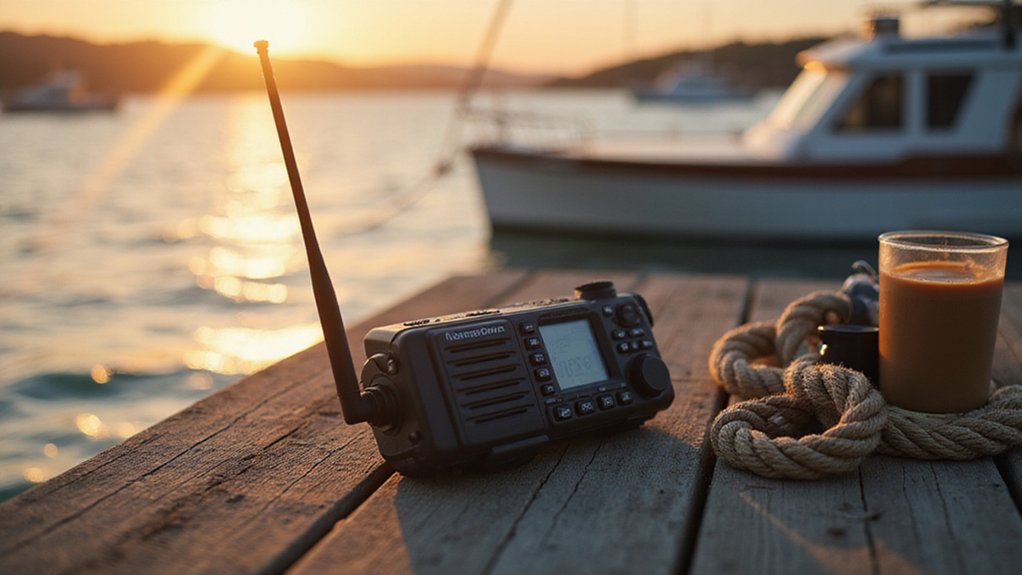
Wondering whether to choose a CB radio or a marine VHF radio? If safety and reliable range matter on water, the answer is clear—marine VHF radios are designed specifically for that environment.
They offer up to 25 nautical miles of coverage and include essential emergency features.
Keep reading to see why a marine radio is your best bet for boating safety.
CB vs. Marine VHF: What’s the Real Difference?
While both CB and marine VHF radios are used for short-range communication, they operate in entirely different frequency bands and function within separate radio environments. CB radios operate at 27 MHz and rely on wave propagation that can sometimes bounce off the ionosphere, allowing signals to travel farther than expected—though typically, you can count on a reliable range of about 5 miles. Marine VHF radios, on the other hand, work within the 156–162 MHz band and stay strictly line-of-sight, making antenna height crucial for maximum distance. Mount your marine antenna high on the vessel’s mast to improve reach. For boaters, selecting the right radio is much like choosing the best fish finder for your vessel—it depends on your specific needs and environment. In contrast to CB radios, marine VHF systems are designed for marine radio communication with features like weather alerts and distress calling. To diagnose issues with your fuel gauge, you should learn to test a fuel sending unit for proper resistance readings.
Power limits also differ significantly. CB radios are limited to 4 watts when transmitting on AM, whereas marine VHF radios can transmit up to 25 watts, providing a stronger signal within their line-of-sight range. Another key difference is licensing: you do not need a license to use a CB radio domestically, but for marine VHF, you may need one depending on your vessel type and communication needs with coast stations. These distinctions highlight how each radio is optimized for its specific environment and purpose—CB radios for general short-distance use and marine VHF for reliable, line-of-sight communication at sea.
Why Marine VHF Dominates for Boaters and Water Communication
Marine VHF dominates for boaters because it is built around a dedicated emergency communication system that CB radio cannot replicate. When you’re on the water, distress priorities take precedence over all other transmissions. Channel 16 is the universal safety frequency and isn’t just another channel—it’s the designated medium for emergency calls. During a MAYDAY or PAN-PAN, every vessel and shore station monitoring nearby uses this channel to respond immediately. Just as proper oil pressure gauge placement is critical for accurate engine diagnostics at idle, correct antenna setup is vital for reliable marine radio performance. For boaters relying on their VHF, having top boat gauges to monitor engine health ensures you can respond to emergencies without mechanical failure.
This system is governed by strict regulations and standardized protocols designed specifically for marine environments. Your distress message must include vessel identity, position, and the nature of the emergency—details that rescue services rely on to act swiftly. Digital Selective Calling enhances safety further by automatically transmitting your MMSI number and GPS coordinates through Channel 70. This digital automation provides precise location data without requiring manual input, a feature entirely absent from CB radio. For boaters, marine VHF isn’t just an optional device; it’s the crucial backbone of water-based communication and safety. A proper marine AM/FM radio antenna is essential for receiving these critical safety broadcasts with optimal clarity and range on the water.

FULL VHF MARINE BAND + NOAA WEATHER: Covers complete VHF marine band (156-158 MHz) PLUS NOAA weather frequencies (162.400-162.550 MHz). 156-163MHz operating range with 5MHz bandwidth, 3.0dBi gain, 50 Ohm impedance. VSWR 1.5:1 at 159.5MHz, less than 2.0:1 across full band. Pre-tuned for all marine channels including Channel 16 (156.8MHz) for distress and safety, plus all 7 NOAA weather channels. Improves signal in both receiving and transmitting for any 156-163MHz device.

Great Product

Marine antenna frequency range: 156-163MH; Gain: 2dBi; Impedance: 50 Ohm; Maximum Power Input-watts: 50W; VSWR: less than 1.8;
CB vs. Marine VHF Range: How Far Can You Talk?
CB radio’s range is typically only 1 to 5 miles in real-world mobile use. Terrain obstacles such as hills, buildings, and natural features cause significant interference, reducing reliable communication further. Claims of reaching 25 miles are rare exceptions and not common in everyday use. To ensure clear signals during critical moments, investing in a high-quality horn for your pontoon boat can help you alert nearby vessels when voice communication fails. To maintain consistent radio performance on the water, a reliable fish finder battery with charger ensures your equipment stays powered during long trips.
In comparison, marine VHF radios with proper antenna installation can easily reach 20 to 25 nautical miles over open water. Even on smaller boats with lower antennas, you can expect effective ranges of 5 to 10 nautical miles. Because VHF operates on a line-of-sight basis, mounting the antenna higher significantly improves coverage. Without land obstructions, interference issues decrease, making marine VHF a much more dependable choice for longer-distance communication at sea. For those who also need a reliable sound signal on deck, a quality horn button can provide an audible alert that complements your radio communication.
Power and Channels: What They Mean for Your Choice
Power output and channel structure greatly influence your experience with CB and marine VHF radios. CB radios typically operate at 4 watts on AM/FM and up to 12 watts on SSB. However, higher power levels do not guarantee longer communication range because antenna installation quality plays a crucial role. Stronger wattage can also drain your battery more quickly, so conserving power becomes important during extended use. For instance, a poorly installed antenna can negate the benefits of a high-wattage setup, similar to how a DIY trolling motor transducer mount requires careful placement for optimal performance. For aluminum boat owners, selecting a sturdy mounting system is equally important to ensure reliable transducer alignment, much like choosing the best fish finder mounts for stable placement. When selecting a radio, consulting a best switch panel review can help you integrate power management efficiently.
Marine VHF radios are designed with a structured channel plan, with specific channels assigned for particular functions, such as Channel 16 for distress calls. Often, these radios operate at only 1 watt on certain channels, which extends battery life but limits how far your signal can travel. The emphasis on organized channels prioritizes safety and emergency communication over casual conversation.
When choosing between the two, consider that CB radios provide simple, fixed channels with higher permissible power output, but your antenna setup and battery capacity are essential for effective range. Marine VHF radios focus on safety and organization, making power less critical because each channel has a designated purpose and power level suited to that use.

Fits all standard 1" marine antennas
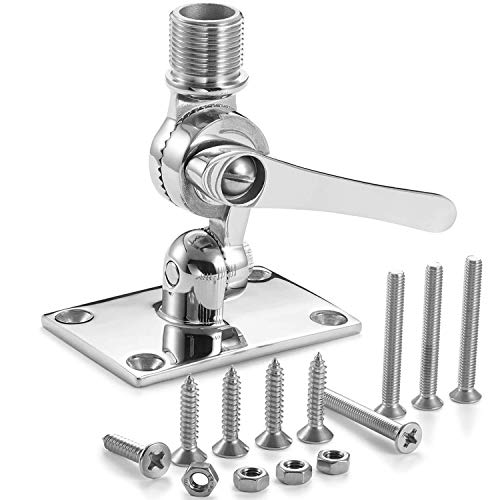
Size: Base measures 3 9/16" x 2 1/2" , 0.87" - 10 thread male, 3/8" hole for cable pass through, Hole diameter 5/16"
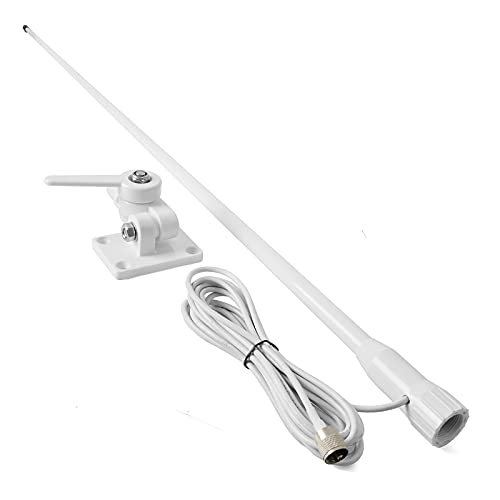
[ELECTRICAL SPECIFICATIONS] Frequency: 156-163MHz; Impedance: 50 Ohm; VSWR: Nominally 1.5:1 at 159.5MHz; Gain: 3dBi; Maximum Power Input-watts: 50W;
CB vs. Marine VHF Licensing: What You Need to Know
Licensing requirements differ significantly between CB radios and marine VHF radios. CB radios do not require an individual license to operate in the United States because the FCC authorizes their use by rule. However, you must ensure your CB radio has proper equipment certification, indicated by an FCC-approved label. A fish finder uses sound waves to detect underwater objects, which is a fundamentally different technology than radio communication.
Marine VHF radios, on the other hand, have more nuanced licensing rules. You do not need a license for domestic recreational boating, which covers most personal use within U.S. waters. But this exemption is limited. If you plan to take your boat on international voyages or use an HF radio or satellite terminal, you will need to obtain an FCC ship station license. Additionally, using a handheld marine VHF radio from land requires a separate marine utility station license. Choosing the optimal mounting position for your equipment, much like finding the correct location for a transducer placement on your boat, directly impacts performance and clarity.
While both types of radios can be operated without a license in certain circumstances, marine VHF licensing regulations are highly specific to the usage context. CB radios remain straightforward, with no licensing hurdles, while marine VHF licensing depends heavily on your intended use and location. For catfish anglers who also boat, a fish finder with clear sonar imaging can be far more critical for locating fish than the type of radio on board.

High Visibility Floating Core - The perfect compact VHF radio for marine use on any size vessel, designed with a high-visibility orange floating core for buoyancy and easy retrieval if dropped overboard
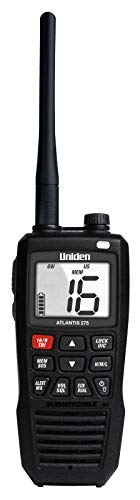
The Atlantis 275 comes with 6 Watts of Big-Ocean Power in a compact Submersible Floating Handheld VHF Marine Radio, and even includes an Emergency Strobe Light and built-in Flashlight Feature.

The Atlantis 155’s submersible, Floating Handheld design allows you to stay secure and connected while having fun on the water.
Which Radio Is Safer in a Real Emergency on the Water?
In a real emergency on the water, marine VHF is the safer option because it is specifically designed for distress calls and connects directly to the Coast Guard and nearby vessels. It offers dedicated emergency channels like Channel 16, which is monitored continuously for distress signals. The Digital Selective Calling (DSC) feature sends an automated distress alert with your GPS position, reducing your workload during high-stress situations. Signal clarity tends to be superior, and with a fixed antenna, your range can extend up to 20–40 nautical miles, making it more reliable in reaching rescue services. For a clean installation, you can apply similar DIY kayak fish finder mount techniques to secure your marine radio antenna. You can confirm the equipment is fully functional by performing a VHF radio check on a non-emergency channel before heading out. If you are building your own setup, you can use a portable fish finder box to neatly house all your marine radio components.
CB radios lack a dedicated marine distress channel and do not have rescue coordination systems like DSC. They cannot send automated alerts, and their standard channels are not monitored by emergency services. Without integrated maritime safety features, your distress call might go unnoticed. For quick and dependable rescue, marine VHF with DSC is clearly the better choice. Relying on a CB radio in emergencies is risky because every second counts.
Where CB Still Makes Sense (But Not for Boating)
CB radios are still useful in many land-based situations where short-range, no-subscription communication is needed. They are particularly effective on construction sites, farms, or off-road trails for quick voice coordination between teams. A simple push-to-talk setup works well, and you don’t need a license to operate them. To get the best performance, position your antenna carefully to maximize that typical 5 to 15-mile range. Their low cost and rugged design make them a practical choice for these jobs. Just keep in mind that maritime safety relies on VHF radios, which offer greater reliability and reach—so use CBs for land-based convoys, not for marine emergencies. For emergencies at sea, however, a registered 406 MHz EPIRB provides satellite-based distress signaling that surpasses both CB and VHF coverage when you are far from shore. For boaters who also want quality audio on deck, investing in 5.25 marine speakers can significantly improve sound output, but this does not replace the need for a proper VHF radio for safety.
Can You Use a CB Radio as a Backup on a Boat?
Using a CB radio as a backup on a boat is not recommended for emergency situations. CB radios lack the Coast Guard’s Channel 16 distress-watch framework, meaning they don’t automatically alert authorities in an emergency. They also do not support Digital Selective Calling (DSC), Maritime Mobile Service Identity (MMSI) linking, or NOAA weather updates, which are crucial safety features. The legal requirements for marine communication favor VHF radios, making CBs non-compliant in many safety protocols. With a typical 4-watt AM CB radio, your reliable range is only about five miles, and unpredictable “skip” propagation can make contact even less dependable. A handheld marine VHF radio integrates into the proper safety ecosystem, providing stronger signals and emergency features suited for boating. Relying on a CB radio could leave you unprotected when you need help most—stick with marine VHF for backup communication.

High Visibility Floating Core - The perfect compact VHF radio for marine use on any size vessel, designed with a high-visibility orange floating core for buoyancy and easy retrieval if dropped overboard
![Standard Horizon HX210 6W Floating Handheld Marine VHF Transceiver [HX210]](https://m.media-amazon.com/images/I/31GYaZEn5GL._SL500_.jpg)
Box Content: HX210 Handheld VHF, Antenna, AC/DC Rapid charger cradle, Documentation | 3-year Waterproof Warranty.

GPS Function;built-in GPS provides precise positioning;RM40 vhf radio marine updates location in real time;ensuring safe navigation and quick rescue when bass fishing; offshore fishing; kayaking
Cost, Range, and Licensing: Your Three Biggest Tradeoffs
Using a CB radio as a backup on a boat involves clear tradeoffs. CB units are generally cheaper upfront and do not require a license, saving you paperwork. However, these savings come with notable limitations. Typical CB radios have a range of only 1 to 5 miles, which is often insufficient for emergency situations at sea. Marine VHF radios, on the other hand, usually provide a line-of-sight range of 3 to 5 nautical miles with a handheld unit, and even farther when mounted with a higher antenna. This increased range can be critical during distress calls. Setting up a CB radio involves simpler antenna installation, but VHF antennas are taller, offering better coverage overall. Battery consumption also differs—CB radios use less power, while VHF radios include Digital Selective Calling (DSC) that can improve safety but requires more power. Licensing is another consideration: CB radios operate under a license-by-rule system, which is straightforward, while marine VHF licensing depends on the boat’s usage and location. Ultimately, choosing cheaper equipment might save money initially but could limit safety during emergencies where range and reliability are crucial.

FLOATING & WATERPROOF DESIGN – Built to IPX7 standards, the Icom M25EVO marine radio floats and flashes for easy retrieval if dropped in water.

Lightweight and portable marine transceiver; RM01 handheld marine radio has a sleek design which is lightweight and easy to carry; it comes with a lanyard for easy hanging on the wrist; very suitable for use in environments at sea; such as youth sailing; fishing enthusiasts; kayak; motorboat; sailing club; beach security etc

Lightweight & easy to use; the RM01P features 3.5W transmit power to help anglers stay connected on rivers and lakes; the included belt clip and lanyard provide convenient carrying and one-hand operation
CB vs. Marine VHF: The Bottom Line for Your Situation
Marine VHF is the essential choice for emergency communication on the water. Since it is designed specifically for distress calls and is actively monitored by the Coast Guard and nearby vessels on Channel 16, it provides a reliable safety net. CB radio does not have a universally monitored emergency channel, making it unsuitable for maritime safety. For boat-to-boat coordination, marina calls, or contacting harbor authorities, marine VHF is the standardized, practical tool. It is built for vessel traffic management and rescue operations, unlike CB, which is more suited for land-mobile or highway communications. Although marine VHF channels are open and lack privacy, this openness is critical for safety and quick communication. If you need immediate help or cooperation from other boats when on the water, prioritize marine VHF over CB radio. It is the clearly better option for distress situations, potential injuries, or navigating near shore.