Figuring out which marine VHF antenna fits your boat can feel tricky, especially with so many options for range and size.
The right choice depends on your boat’s size, typical sea conditions, and how far you need your signal to reach.
Knowing how gain and placement affect performance helps you get the best communication for your time on the water.
The full details are below.
Which Marine Antenna Type Is Best for Your Boat?
Choosing the right marine antenna gain depends largely on how your boat moves. For boats that pitch and roll heavily, such as small skiffs, a 3 dB antenna’s broader pattern helps maintain a stable signal, reducing the risk of losing connection off-axis. Conversely, a 9 dB antenna has a narrower beam, which works better in calm conditions but can drop signals if your boat moves a lot. For most boats sized 20 to 35 feet, a 6 dB antenna offers a balanced mix of range and sea-state tolerance. Additionally, antenna durability is crucial—fiberglass and stainless steel whip designs withstand harsh marine environments, ensuring consistent performance and minimizing signal interference. Matching your antenna’s gain to your vessel’s typical motion will keep your communication steady, without chasing the highest possible gain. For example, when comparing options, consider top speedometer picks to further align your onboard electronics with your boat’s specific handling characteristics. For further guidance, refer to a quality fish finder review that also stresses the importance of matching gear performance to your specific vessel conditions for the best value. A reliable horn button can similarly enhance your boat’s safety systems by providing a durable, easy-to-use control in all weather conditions.

Covers all marine band frequencies

Frequency Range: VHF 136-174MHz; Compatible with Handheld Marine VHF Two Way Radio;

Type: Folded dipole antenna
Whip vs. Masthead: How Marine Antennas Compare for Different Boats
Masthead placement dramatically enhances your VHF radio’s range because line-of-sight is crucial for effective communication. Every additional foot of height extends your horizon, making it easier to reach or be reached by other vessels farther away. On sailboats, a lightweight stainless steel whip is typically mounted at the masthead to leverage maximum height while avoiding deck clutter. Powerboats, which lack a mast, usually use longer, higher-gain antennas placed lower down, where flexible placement often outweighs the benefits of extra altitude. For boaters who also want clear audio entertainment, choosing a VHF setup that works alongside top marine bluetooth speakers ensures versatile sound on the water. When comparing different models, the best fish finder for boat often includes integrated GPS features that can help you mark productive fishing spots.
Durability at the masthead is vital because this spot endures wind, vibration, and constant salt exposure. Choose rugged fittings and weatherproof connectors such as N-type over standard PL259 connectors, which are more prone to water ingress. Always maintain at least two meters of separation between two VHF antennas to prevent signal interference. For most recreational boats, a 3 dB gain whip offers a good balance between size and effective communication range, but mounting it higher will always improve your reach. For optimal audio clarity, pairing your VHF antenna setup with a top marine bluetooth amplifier can significantly enhance sound quality when communicating over long distances.

Great Product

Fits all standard 1" marine antennas

Brass and copper elements
When Should You Choose a High-Gain Marine Collinear Antenna?
A high-gain marine collinear antenna is ideal when your boat operates mainly in open water or offshore. These antennas provide substantially better horizon coverage by compressing the vertical beam, which concentrates power where you need it for distant ships and shore stations. The signal polarization remains vertical, perfectly matching standard marine VHF radios and emergency channels. For a similar application in ice fishing, you can apply the same principle of selecting gear based on environment by checking out top Lowrance fish finders reviewed for performance in open, harsh conditions. Understanding how to interpret the returned signal strength and target separation on a display is crucial, which parallels reading sonar for accurate underwater interpretation. Just as a pitot tube offers a simple and reliable alternative for measuring boat speed without complex electronics, this antenna type prioritizes straightforward performance for long-range communication.
Constructed from rugged fiberglass, these antennas are built to withstand constant salt spray and wind, ensuring durability in harsh marine environments. Mount the antenna high at your masthead to optimize line-of-sight performance. Keep in mind that higher gain narrows the vertical pattern, so this type of antenna works best when your boat’s heel angle remains minimal. If your vessel rolls heavily, the signal can weaken during tilt, reducing communication reliability. For fixed, long-range communication setups in open water, a high-gain collinear antenna offers the best combination of reach and durability.

Marine vhf antenna; 3.5dbi gain; 156-163 MHz; 43.3inch/1.1m; coaxial feeder 275.5inch/7m(PL-259 connector); sufficient length of cable; MA06 marine radio antenna allows you to install the antenna anywhere
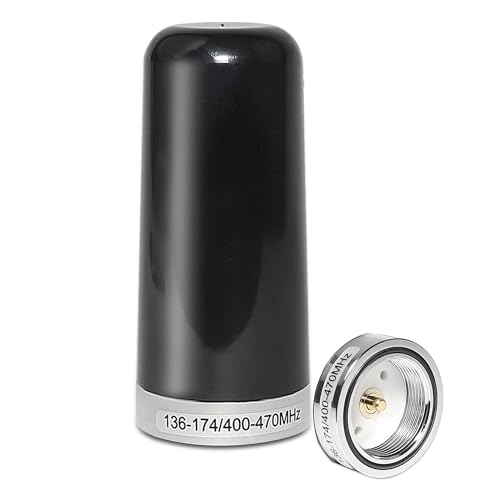
Frequency Range: This NMO mount dual band antenna features VHF136-174MHz and UHF 400-470MHz frequency, provides a 2.5 dBi to 3 dBi gain; Ideal solution for your GMRS and UHF mobile radio

FULL VHF MARINE BAND + NOAA WEATHER: Covers complete VHF marine band (156-158 MHz) PLUS NOAA weather frequencies (162.400-162.550 MHz). 156-163MHz operating range with 5MHz bandwidth, 3.0dBi gain, 50 Ohm impedance. VSWR 1.5:1 at 159.5MHz, less than 2.0:1 across full band. Pre-tuned for all marine channels including Channel 16 (156.8MHz) for distress and safety, plus all 7 NOAA weather channels. Improves signal in both receiving and transmitting for any 156-163MHz device.
Are Directional Marine Antennas Ever Practical for a Moving Boat?
Directional marine antennas are generally not practical for a moving boat because your vessel’s heading changes constantly. The narrow beamwidth requires constant realignment, which is difficult to manage on a vessel that turns, rides waves, or adjusts course frequently. Each movement causes the antenna to lose its optimal alignment, leading to signal drop-offs. The more focused the beam, the more sensitive this problem becomes. Signal polarization introduces additional challenges. As your boat moves, the polarization angle shifts, creating mismatches with stationary targets. Without an active tracking or stabilization system, maintaining a reliable connection becomes nearly impossible. You’re fighting both the antenna’s pointing direction and the polarization angle simultaneously. A marine radio offers clearer audio and longer range than CB, making it a far better choice for open-water communication. For comparison, many fish finder users benefit from a dedicated charger and battery setup to maintain consistent power for their electronics in stationary positions. However, if your boat is stationary—at anchor, docked, or working in a fixed position—a directional antenna can be effective. In these cases, you can aim it precisely at a known target and take advantage of its focused beam for better signal strength. For underway navigation or routine movement, though, it’s best to stick with an omnidirectional whip antenna, which can handle motion and polarization changes without constant adjustments. A fuel pump is a key component for delivering fuel from the tank to the engine, while a sending unit measures the fuel level.

Waterproof FM/AM Car and Marine Radio Antenna Replacement - 15 3/4 inch stereo antenna comes with mounting base and stub. So the car radio antenna also suitable for golf cart ATV UTV RV marine truck excavator tractor RVR yacht pontoon boat. There is no need to purchase an antenna base separately.

Excellent Perfomance:Range of up to 10 miles for all Marine Band Car Home radio frequencies

Item Package Quantity - 1
Mounting Height and Materials: What Determines Your Best Marine Antenna Setup
Your VHF range depends far more on your mounting height than on antenna gain or radio power. Because you are limited by line-of-sight, raising your antenna from 15 feet to 25 feet on a hardtop, radar arch, or masthead can double your horizon distance from about 10 miles to over 15 miles. Mount your antenna in a clear, open area away from metal structures and other antennas to improve performance and reduce interference. Proper orientation and placement are key to maximizing your communication range. For catfish anglers who fish wide river bends or large reservoirs, pairing a high-mounted antenna with a top-rated fish finder ensures you can call for help while locating deep channel structure. For a clean, low-profile installation on smaller boats, a scupper hole transducer mount can also serve as a secure, corrosion-resistant foundation for your VHF antenna base. Understanding what the screen readouts mean on your fish finder can significantly improve your ability to identify deep channel structure and fish-holding features.
Material choice is just as important. Use stainless steel hardware, especially SS316, to resist the corrosive effects of saltwater. Inspect your coax regularly, as damaged cable severely diminishes signal quality. Longer antennas require additional support; adding an upper clamp for two-piece whips over 10 feet helps prevent flexing at the base. Ensuring your mounting orientation and hardware quality are correct guarantees your VHF antenna performs at its full potential, giving you every mile of range you’ve earned.

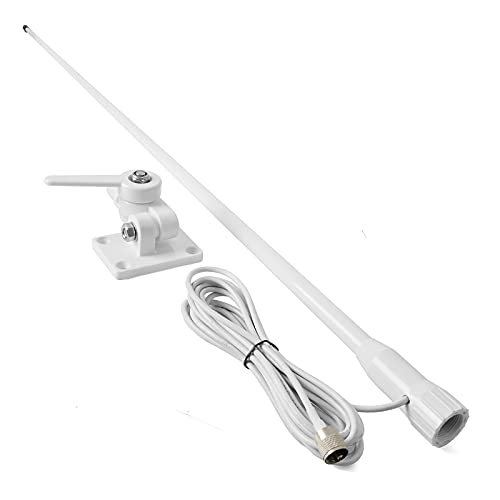
[ELECTRICAL SPECIFICATIONS] Frequency: 156-163MHz; Impedance: 50 Ohm; VSWR: Nominally 1.5:1 at 159.5MHz; Gain: 3dBi; Maximum Power Input-watts: 50W;

Size: Thread: 1" x 14 (Standard). Recommended for installation on 7/8 inch(22 mm) and 1 inch(25.4 mm)vertical, horizontal or oblique rails.