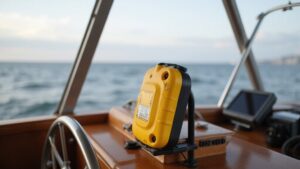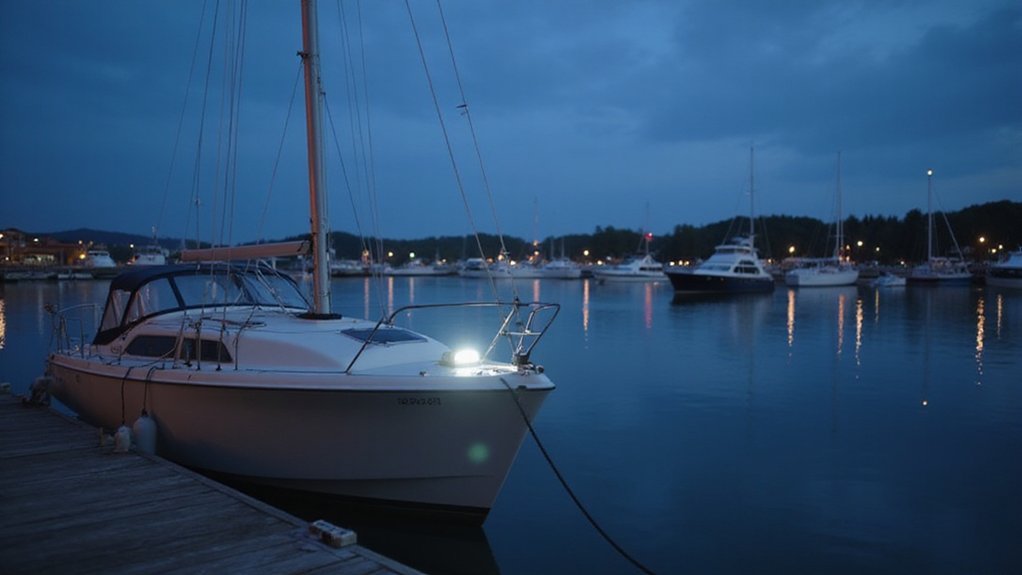
Wondering where to put the all-round white light on your boat? This light should be mounted on your boat’s centerline, at least one meter above your sidelights, to provide a clear 360-degree beam without shadows.
Proper placement helps you stay visible and compliant during night anchoring or maneuvering.
Keep reading for tips on positioning it correctly and ensuring safety at sea.
What Exactly Is an All-Round White Light?
An all-round white light is a continuous, unbroken beam that shines in every direction around your boat, covering a full 360 degrees of the horizon. Its primary purpose is to serve as a navigational signal that is easily recognized from any angle at sea or on the water. The light is strictly white, part of the standard color set for navigation lights, ensuring instant recognition and reducing confusion among vessels. When interpreting sonar returns on a fishfinder, such as the Garmin Striker 4, understanding the difference between fish arches and clutter is crucial for accurate reading. When selecting equipment, you might also consult reviews of top fish finders to ensure your navigation and fishing electronics work together seamlessly. This design has evolved from simple lanterns used in the past to today’s precise fixtures that comply with international navigation regulations, such as COLREGs. A binnacle compass, often mounted near these lights, must maintain degaussing-free zone clearance to prevent magnetic interference. Its key feature is full-circle visibility, which means it cannot be limited to a forward-only beam or a partial arc. Instead, it provides a uniform white glow accessible from all directions. You typically see this light serving as an anchor light when your vessel is stationary or as a basic underway light on smaller boats. The meaning of its appearance depends on the surrounding lights and their configuration, so you must interpret the entire lighting picture carefully rather than relying on the white light alone.

Translucent White Plastic, Anti-Glare Screw On Globe For New Style Attwood Model All-Round Navigation Lights

ALL‑AROUND VISIBILITY LIGHT OUTPUT: Enhances safe operation from sunset to sunrise or anytime there is poor visibility

ALWAYS RELIABLE - The all-round light is an important piece of safety equipment on your boat and must be able to function in all weather conditions. Unlike other, cheaper lights, our lights are silicone sealed and IP66 rated.
Why It Must Be Mounted on the Centerline
Mount it on your boat’s centerline to ensure the all-round white light casts an unbroken 360-degree beam. Off-center placement can cause shadows from the hull, mast, or gear, breaking the light’s full arc and reducing visibility from certain angles. The centerline is the standard placement according to COLREGs unless it’s not practicable. Proper mounting guarantees equal visibility to port, starboard, ahead, and astern, which is crucial for safety and compliance. Using your Garmin Striker 4 to verify depth and structure beneath the mounting area can help avoid interference from deck fittings. Obstructions from asymmetrical deck structures can mask your signal, so always prioritize centerline placement first. While exceptions exist for tight or complex layouts, following this rule helps ensure your light remains unobstructed and clearly visible from all directions. For reliable identification of switch functions in the helm area, consider using top boat labels that complement your lighting setup. For superior audio clarity on deck, consider pairing your setup with top marine sound bars that resist harsh marine environments.
How High Above the Sidelights to Mount It
To meet COLREG standards, you should mount your all-round white light at least 1 meter (about 39 inches) above your sidelights. This vertical separation ensures other vessels can accurately interpret your boat’s profile. Measure from the filament center of your sidelight to the filament center of the white light, not just the housing edges or deck height. Proper spacing is especially important on small power-driven vessels under 12 meters that use the all-round light as a substitute for a masthead light. Without the correct height difference, your vessel’s size and direction may be confusing to others, leading to potential miscommunication or misrepresentation on navigation charts. If you lack enough height, consider installing a 1-meter mast segment on the centerline to achieve clear, unmistakable separation between your white and colored lights. A blocked pitot tube, for example, can cause speed loss and inaccurate readings, similar to how poor light placement leads to misinterpretation. Ensure everything is mounted securely to maintain proper visibility and compliance. For accurate interpretation on the water, you can use the Hook Reveal 5 to confirm your light separation distance is correctly set. A properly functioning pitot tube provides reliable speed data, just as correct light height ensures safe navigation.

360° All-Round Super Bright: 51PCS SMD2835 LEDs emit 6000-6500K daylight white light, this masthead lights ensure you remain visible to other boaters at night, significantly increase safety at night
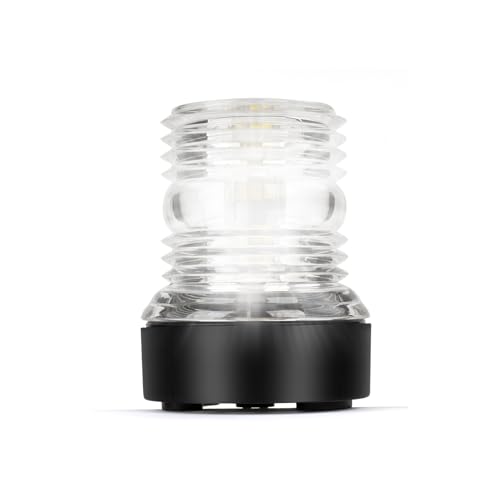
360° All-Round Visibility Navigation Lights: Meeting USCG’s requirement, providing full-circle illumination for enhanced marine safety. Ideal as masthead lights, boat stern light, or boat anchor light with continuous 360° white LED coverage.

Premium Boat Lights: 24-Inch UV-resistant boat light delivers 360-degree visibility, featuring an IP65 splashproof design
The 6-Degree Rule: Keep Masts From Blocking the Light
To prevent your mast from blocking your all-round white light, ensure no obstruction exceeds a 6-degree angle of your horizon. Mount the light on the centerline and high enough to clear cabin lighting structures and crew movement, which reduces shadows and maintains deck illumination. The light should be positioned so that your mast or rigging do not block more than 6 degrees of its visibility. If a single light cannot avoid a sector blockage greater than 6 degrees, use two all-round lights spaced less than 1.28 meters apart. At a nautical mile, these will appear as one, maintaining your 360-degree visibility. Adjusting your sonar sensitivity helps distinguish fish from structure, much like fine-tuning a light to avoid obstructions. Avoid placing the light behind antennas or backstays, as this can create shadows or reduce visibility. The goal is to achieve an unbroken arc of light; no fixed structures should cut into it. When selecting your light source, consider that marine speakers are built to withstand moisture and UV exposure, similar to the durable lighting required on a boat. For the best results, consult a top speedometer picks review to ensure your navigation instruments are as reliable as your lighting.

✔Durable Material: This marine anchor light is a 360° round shape with transparent ABS plastic shell and Black Plastic Base (Included), providing maximum strength, anti-corrosion, good waterproof performance, light weight and long lasting life, 100% brand new, quality assurance

* Installation is easy with a pre-wired wire harness.

Provides outstanding illumination to ensure your boat is visible on the water
Placement for Power-Driven Boats Under 12 Meters
For boats under 12 meters, a single all-round white light can replace separate masthead and stern lights. Mount this light at least 1 meter above your sidelights and position it as close to your fore-and-aft centerline as possible. If centerline mounting isn’t practical, offset the light but ensure your sidelights are combined into one lantern on the centerline for better visibility. This configuration simplifies installation on small runabouts or center consoles, making it easier to read navigation charts and coordinate emergency signaling. Make sure the white light provides a full 360-degree visibility without significant obstruction. Keep masts or fittings from blocking more than 6 degrees of its arc. Additionally, your sidelights should match the white light in placement to maintain proper visibility and compliance. If placement conflicts arise, consider using a combined lighting unit to ensure all requirements are met efficiently. Understanding what anchor light means is essential for safe nighttime navigation. When wiring the all-round white light, use a horn relay to handle higher current loads and prevent switch damage. A failed horn relay often shows signs like a non-functioning horn and requires testing for proper voltage readings and continuity.
Special Rule for Boats Under 7 Meters and Under 7 Knots
If your boat is under 7 meters long and cannot exceed 7 knots, you can use a single all-round white light instead of the standard navigation lights. This exemption recognizes that small, slow vessels find it difficult to mount complex lighting systems. For those who enjoy DIY projects, a similar resource for installing electronics is a guide for a DIY kayak fish finder mount, which provides step-by-step instructions for a clean setup. For shore-based anglers, a top fish finders review can help identify portable models that work well from the bank. The all-round white light must be visible in all directions, 360 degrees, to serve as your primary signal at night. Although sidelights are not strictly required under this rule, it’s advisable to add them if practical because they provide additional information about your heading to other boats. Keep in mind that this exception does not eliminate your responsibility to display the appropriate lights for your operating conditions. Once your vessel exceeds 7 meters or 7 knots, this simplified lighting setup no longer applies, and you must revert to the full standard lighting scheme. Use the all-round white light to maximize visibility and always consider sidelights if it can enhance safety during navigation. For anglers using small watercraft, a dedicated fish finder for float tube can similarly enhance navigation and safety by revealing underwater hazards.
Where to Show the Light When at Anchor
When anchoring your boat, the all-round white light must be placed where it can be seen from every direction, providing 360-degree visibility over the horizon. It should be mounted high enough and in an unobstructed position—free from masts, sails, or deck gear blocking the view. This placement ensures other vessels can clearly identify you as an anchored boat and differentiate you from navigation markers and shore lights, complying with marine regulations.
For boats under 50 meters, a single all-round white light is sufficient. Position this light near the boat’s forepart, such as at the masthead on a sailboat, to maximize visibility ahead and to both sides. Avoid mounting it low on the vessel, as lower positions can make it harder for others to see your nighttime presence. The light must stand out clearly and be mounted in a location that serves the purpose of maximum visibility—following the rule of best sightlines over the horizon.
Two All-Round White Lights for Boats Over 50 Meters
For boats over 50 meters, you need two all-round white lights instead of just one. The forward light is mounted near the bow, positioned higher than the aft light, which is placed at or near the stern. This setup ensures both lights can be visible from all directions, each showing a continuous 360-degree arc. Confirm that both lights are operating correctly and that their beams do not have gaps. Think of these lights as navigation mirrors—they communicate your vessel’s size, orientation, and heading to other mariners. Proper crew training is essential so everyone understands the placement and visibility requirements. Keep the forward light above the aft light and check for any obstructions that could block their view. This arrangement clearly signals to others that you are a larger vessel under way, helping them judge distance and direction more accurately. Unlike the stern light, which must always be white and visible across a 135-degree arc, these all-round lights provide a complete 360-degree signal for vessels over 50 meters. For optimal performance, consider mounting these lights with Lowrance transducers to ensure reliable marine electronics integration.

High Brightness: The AMBIPASION boat anchor light features 51 SMD2835 LEDs, providing ultra-bright white light with 360° coverage. Our boat stern light run on AC/DC 12-24V, offering durable, energy-saving illumination.

New upgrade: Brand new design, compared with the models on the market, our 31mm marine LED festoon bulb has a built-in heat dissipation aluminum tube, which greatly improves the heat dissipation efficiency of the bulb, allowing the bulb to maintain high brightness for a longer time. Brightness upgrade, only 1.5w can have 200 lumens of light output, 360-degree light, no dark spots, surpassing the limitation of the old single-sided 180-degree light on the market, no matter from which angle, you can enjoy uniform and bright light

Superior Visibility for Night Safety: Maintain peak security with this high-bright boat lights that provides 360° all round of visibility; ensures your boat remains clearly seen by other vessels during night fishing or low light conditions
What Visibility Range Is Required for Your Boat?
The minimum visibility range required for your boat depends on its size. For vessels under 50 meters, a 2 nautical mile range for your all-round white light is standard. This ensures other boaters can see you at a safe distance, especially in low-light conditions. For vessels 50 meters or longer, a 3 nautical mile range is necessary to meet safety standards.
Visibility isn’t determined solely by wattage; other factors influence how well your light can be seen. Regularly check to ensure your light is clean and functioning properly. Dirty lenses or weak bulbs will reduce the effective range and compromise your safety. Good color contrast against the surroundings also helps ensure your light stands out. Always verify your light’s performance at night to confirm it meets the required visibility range, and be aware that local regulations may impose stricter standards. Ignoring these guidelines can make your boat invisible and increase the risk of accidents.

Great looking light, designed to provide years of safe boating

High-quality lighting option for boat owners who need a reliable and efficient anchor light for their T-TOP pontoon or fishing boat

When to Displace the Light Off-Centerline
All-round white lights under certain conditions can be displaced off the fore-and-aft centerline, but only as an exception. For power-driven vessels under 12 meters, this is acceptable if fitting the light on the centerline isn’t practicable due to maintenance constraints such as limited deck space or wiring issues. When you do displace the light, navigation rules require you to combine the sidelights into a single lantern placed as close to the centerline as possible or aligned with the displaced light. Although displacement is permitted, the centerline remains the preferred location to ensure symmetrical visibility. Off-center placement is a narrow exception and should not be your default choice. You must also keep the light’s full 360-degree arc unobstructed, with no obstruction exceeding 6 degrees. Use this workaround only when necessary; it is not a standard installation practice.